You’ve just gotten off the phone with an auto glass shop — or maybe you’re reading your ICBC claim summary — and suddenly you’re drowning in terms you didn’t ask for. OEM. OEE. Aftermarket. The quote differences are hundreds of dollars, nobody is explaining why, and you’re wondering if it even matters.
It matters. Sometimes a great deal. But the answer isn’t the same for every driver, every vehicle, or every budget.
The goal of this guide is simple: give you the honest, technically accurate information that a certified auto glass professional would give their own family member, so you can walk into any shop and make a decision you feel confident about. We’ll cover what each glass type actually is, how it affects your vehicle’s safety systems, what ICBC will and won’t pay for, and exactly which option makes sense for your specific situation. No fear-mongering. No upselling. Just the facts.
Not sure which windshield is right for your vehicle? Get honest advice from our certified technicians, no pressure, no sales pitch, just clear answers for your make and model.
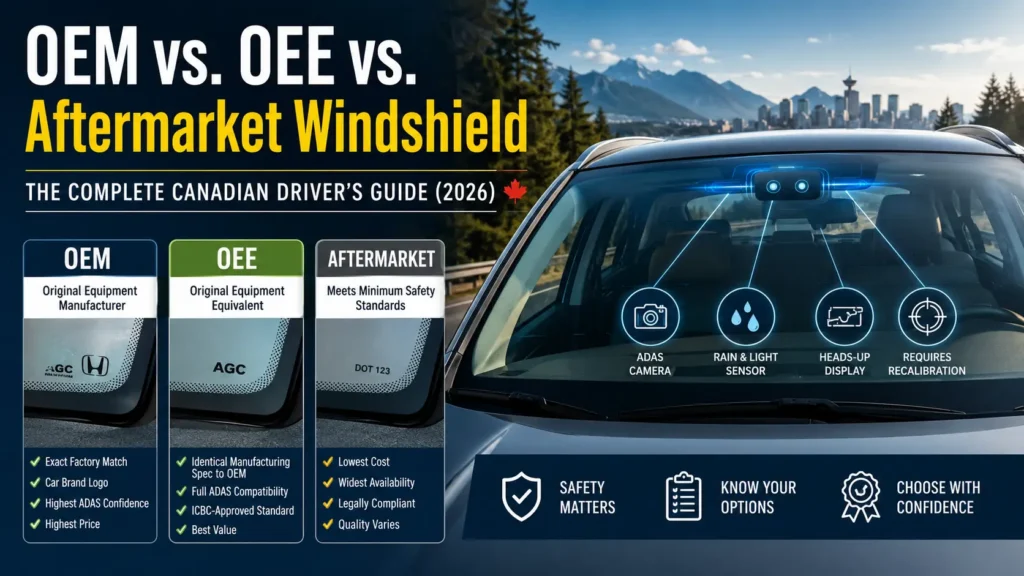
What Do OEM, OEE, and Aftermarket Actually Mean?
Before anything else, let’s establish a shared vocabulary. These three categories represent a spectrum of glass origin, manufacturing precision, and price — and understanding where each sits on that spectrum is the foundation of every decision that follows.
Original Equipment Manufacturer (OEM)
OEM glass is made by the exact same factory that produced your vehicle’s original windshield, under direct contract with your car’s manufacturer.
Companies like AGC and Pilkington supply glass to both automakers on the assembly line and to the replacement market. Because it comes from the same source, the fit, optical clarity, and every technical specification are identical to what left the factory.
You’ll recognize OEM glass by its “bug” (the small stamp in the corner of the windshield) which carries both the glass manufacturer’s name and your car brand’s logo. It is the most expensive option, typically ranging from $450 to $1,500 or more in Canada.
Original Equipment Equivalent (OEE)
OEE glass is manufactured by approved third-party suppliers who are not under direct contract with your car brand but build their glass to the identical engineering specifications. Think of it as a licensed copy: same dimensions, same optical standards, same safety performance, different factory.
The bug will carry the glass maker’s own logo but not your car manufacturer’s badge. OEE is the most common professional recommendation for most drivers and is what ICBC typically authorizes under a standard comprehensive claim. Prices generally range from $280 to $650.
Aftermarket
Aftermarket glass meets the legal minimum safety standard required by Transport Canada (CMVSS 205), but is manufactured without reference to OEM specifications. Quality varies significantly between brands.
The bug carries only a generic DOT code. Aftermarket glass often omits features found in OEM and OEE glass — such as the acoustic interlayer that reduces cabin noise, or the specific optical clarity required by ADAS camera systems. It is the cheapest option, typically $150 to $380, but for many modern vehicles it carries real trade-offs.
How to Read the Bug on Your Windshield
Every piece of automotive glass in Canada must carry a printed stamp in the lower corner, technicians call it the “bug.” If your car brand’s logo appears alongside the glass maker’s name, the glass is OEM. If only the glass maker’s logo is present, it is OEE or aftermarket.
The DOT code on the stamp can often be traced online to confirm the exact manufacturer. When getting a quote, always ask the shop which specific brand of glass they are supplying — reputable OEE names include AGC, Pilkington, PGW, and Guardian.
The Technology Factor — ADAS and Sensors
A decade ago, windshield replacement was straightforward: right size, right shape, done. Modern vehicles have fundamentally changed that. Today, the glass in front of you is not just a barrier — it is a precision optical instrument that your vehicle’s safety systems depend on.
What lives in your windshield zone
The ADAS camera is mounted directly behind the rear-view mirror. It powers lane departure warning, automatic emergency braking, traffic sign recognition, and adaptive cruise control. It requires glass with zero optical distortion in its field of view. Even a minor optical imperfection in the glass can cause the system to misread lane markings or fail to detect a vehicle ahead in time.
The rain and light sensor is positioned in a defined zone at the top center of the windshield. It detects moisture and ambient light to auto-activate wipers and headlights. Aftermarket glass may not have the correct optical clarity or coating in this specific zone, causing the sensor to malfunction or give erratic readings.
The Heads-Up Display, or HUD, projects speed and navigation data onto the windshield surface. HUD windshields contain a special wedge-shaped PVB interlayer to prevent double-imaging of the projected light. If a non-HUD glass is installed on a HUD-equipped vehicle, the display becomes blurry and unusable.
The recalibration requirement every driver must understand
Any windshield replacement on an ADAS-equipped vehicle requires a professional camera recalibration after installation. Even if the new glass is dimensionally identical to the original, the camera’s physical position relative to the road changes slightly during removal and reinstallation — enough to make the system inaccurate.
Recalibration uses one of two methods: static calibration, which uses a target board in a controlled shop environment, or dynamic calibration, which involves driving the vehicle on a road while specialized software resets the camera’s reference points. The right method depends on your specific vehicle make and model.
Recalibration typically adds $150 to $350 to the total cost of the job, and is frequently covered under ICBC glass claims when properly itemized. Driving with an uncalibrated ADAS system is a genuine safety risk — the system may appear to be working normally while operating outside its accuracy tolerance.
Making the Right Choice
There is no single correct answer for every driver. Here is a straightforward guide based on your situation.
Choose OEM if
your vehicle is under a lease agreement (most leases contractually require OEM-spec glass); your car is still under the manufacturer’s bumper-to-bumper warranty; you drive a luxury vehicle and want an exact factory match; or the peace of mind of a guaranteed factory-spec replacement is worth the premium to you.
Choose OEE if
you own your vehicle and want the best combination of quality and value; your car has ADAS and you want full optical compatibility without paying OEM prices; or ICBC is covering the claim and you want to work within what they authorize without sacrificing quality.
OEE from a reputable supplier is what the majority of professional technicians would choose for their own vehicles.
Choose Aftermarket if
your vehicle is older, high-mileage, and you plan to sell or retire it soon; it has no ADAS systems; and you want the lowest possible cost with a legally compliant result. If you go this route, use a reputable brand, insist on AGSC-certified installation, and confirm the glass meets UV and acoustic specifications in writing.
A quick pros and cons summary
OEM pros: exact factory match, car brand logo preserved, highest ADAS confidence, required for most lease returns. OEM cons: highest cost, longer lead times, overkill for older vehicles.
OEE pros: identical manufacturing spec to OEM, fully ADAS-compatible from top brands, ICBC-approved standard, excellent acoustic and UV performance, faster availability. OEE cons: car brand logo absent, quality varies between suppliers, may not satisfy strict lease inspections.
Aftermarket pros: lowest cost, widest availability, legally compliant. Aftermarket cons: optical quality may impair ADAS, often lacks acoustic interlayer, UV protection may be lower, not acceptable for leased vehicles, inconsistent quality control between brands.
Conclusion
You came into this article wondering whether the type of glass in your windshield actually matters. The answer, as you now know, is: it depends, but it’s always worth understanding before you commit.
For most BC drivers with ADAS-equipped vehicles, quality OEE glass from a reputable supplier, installed by an AGSC-certified technician with a proper recalibration, is the smart choice — excellent safety performance at a price that makes sense.
For leased vehicles, luxury cars, or those still under manufacturer warranty, OEM is worth the premium. For older vehicles with no advanced technology, legitimate aftermarket glass gets the job done legally and affordably.
What matters equally than glass type is who installs it. The adhesive, the technique, the cure time, and the recalibration are what stand between you and a structurally compromised vehicle. At BC Auto Glass, every installation follows AGSC standards, every ADAS vehicle receives a professional recalibration, and every job is backed by a lifetime workmanship warranty.
If you’re still unsure which glass is right for your vehicle, call us. Tell us your make, model, and year, and one of our certified technicians will give you a straight answer, not a sales pitch.