Two windshield quotes can describe very different jobs. One price may include work the other leaves out, and the right glass for one vehicle may not suit another. A windshield also does more than keep out the weather: the Auto Glass Safety Council, a US-based industry group, says it is part of a vehicle’s passenger restraint system and that correct installation matters for airbags to work as designed (AGSC).
The five questions below help you compare shops on what matters. Answers vary by vehicle, so treat them as prompts for a conversation, not a pass-or-fail test.
1. Will the installer follow my vehicle maker's procedures?
Vehicles are built differently, so the steps for removing and fitting a windshield differ too. Some need trim, a cowl panel, sensors or other parts removed for access; others may not. Tesla’s published Model 3 procedure, for example, has technicians remove the cowl screen panel, the forward camera and several trim pieces, and it names the primers and urethane to use (Tesla Model 3 service manual). That is one vehicle’s instructions, not a rule for every car.
Some shops also follow an industry standard. The best known in North America, ANSI/AGSC/AGRSS 005-2022, says adhesive work should follow the relevant manufacturer’s instructions (AGSC). It was written around US regulations and is voluntary, so it is not BC law, but it is a fair thing to ask about.
What to ask:
- Do you use the manufacturer’s service information for my make and model?
- Which adhesive will you use, and is it suited to my vehicle and the weather today?
- Will any parts, such as clips or mouldings, be replaced rather than reused?
What varies: access steps, adhesive and primers, replacement parts, and any sensors that must come off.
2. What glass is going in, and does it suit my vehicle?
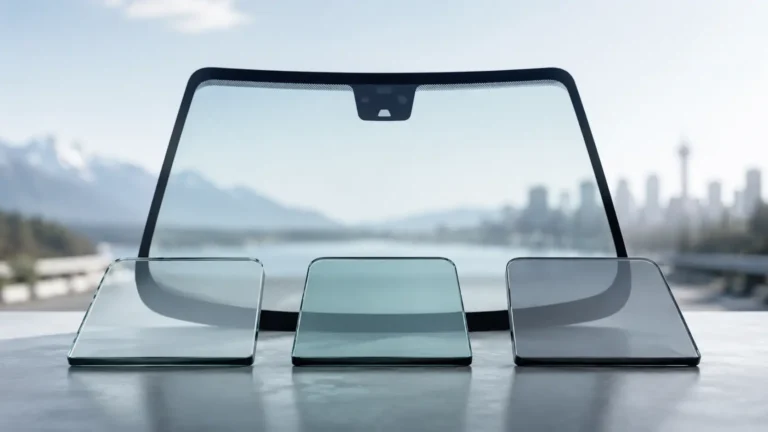
Windshields can differ by year and trim in features such as camera mounts, rain sensors and heads-up display compatibility, so the right part depends on your exact vehicle. Toyota’s guidance for 2016–2024 models, as summarized by I-CAR, notes that some non-genuine glass may have a black border that blocks the camera’s view or lack the camera bracket (I-CAR). That is Toyota’s guidance for its own vehicles, not a verdict on any category of glass.
You will hear the terms OEM, OEE and aftermarket. OEM usually means glass from the maker of your vehicle’s original; OEE and aftermarket describe glass from other suppliers (BEMAC). Shops do not always draw the line between OEE and aftermarket in the same place, so ask what they mean.
What to ask:
- Which brand and type of glass is quoted, and is it intended for my exact vehicle?
- Does it include the features my windshield has, such as a camera mount, rain sensor or heads-up display area?
- If there is more than one option, what are the differences for my vehicle?
Neither label guarantees a better or worse fit; compatibility with your vehicle is what counts. Our guide to OEM, OEE and aftermarket windshields explains the terms in more depth.
What varies: the options available depend on your vehicle’s make, year, trim and equipment.
3. Does my vehicle need ADAS camera calibration afterwards?
Advanced driver-assistance systems (ADAS), such as lane-keeping, automatic emergency braking and adaptive cruise control, often rely on a camera or sensor mounted at the windshield. Whether anything needs calibrating after a replacement depends on the vehicle maker’s instructions and the work performed. Toyota’s guidance for newer models, as summarized by I-CAR, calls for calibrating the forward camera after a windshield is replaced (I-CAR). Tesla’s Model 3 procedure does not use the word calibration, but it calls for a forward camera pitch verification once the cowl screen is back on (Tesla). The idea is similar and the wording differs, which is why it pays to ask rather than assume.
Not every vehicle has a windshield camera. Rather than relying on whether a warning light appears, ask the shop to check the manufacturer’s requirements for your vehicle. BC Auto Glass lists ADAS recalibration on its windshield replacement page, and we can tell you what applies to your vehicle when you call.
What to ask:
- Does the manufacturer call for calibration or a camera check on my vehicle?
- Is it included in the quote, or priced separately?
- How will it be done? Methods differ by vehicle and can be static, dynamic or a combination (AGSC).
- Will I get a record of the result? The voluntary US standard says an installer who provides calibration should give the owner the outcome (AGSC).
- If I want mobile service, is calibration suitable at my location?
What varies: whether your vehicle has a windshield camera or sensors, the method, and whether the job can be done away from a shop.

4. When can I safely drive after the installation?
Two different times matter. Minimum drive-away time is how long the vehicle should stay stationary after installation so the adhesive can bond properly; full cure takes longer (AGSC). There is no single waiting period, because the AGSC says times vary with the adhesive and the conditions at the time of the job.
For illustration only: Tesla’s Model 3 procedure uses a urethane that needs at least one hour before the car is driven (at -18°C or warmer) and advises the customer to avoid high speeds and speed bumps for 24 hours (Tesla). That is one adhesive on one vehicle, and your installer’s figures may differ.
The voluntary US standard says the owner should be told the minimum drive-away time before and after installation, and that dynamic calibration can begin only after that time has passed (AGSC). A job that includes a road-based calibration may therefore take longer overall.
What to ask:
- What is the minimum drive-away time for my job, given the adhesive and today’s conditions?
- When can I wash the car, and does that include automatic car washes and pressure washing?
- If retaining tape is used, when should I remove it?
- Is there anything else I should avoid after I drive away, and for how long?
- Who should I contact if I notice wind noise or a water leak after the replacement?
- Can I have those instructions in writing?
What varies: the adhesive, temperature and humidity, and the vehicle.
5. What is included in the quote, and what does the warranty cover?
A quote is only comparable if you know what it covers. Ask for it itemized, and ask for the warranty terms in writing.
What to ask about the quote:
- Does the price include the glass, adhesive, any replacement parts, calibration if it is needed, taxes and any mobile-service charge?
- If I am claiming through ICBC, will you start the claim and bill ICBC directly, and what is my deductible? ICBC says that under Comprehensive coverage a deductible applies when a windshield has to be replaced rather than repaired, so check your own policy for the amount (ICBC). Our ICBC claims page has more on how claims work with us.
What to ask about the warranty:
- What does it cover (for example leaks, installation workmanship or calibration), and for how long?
- Does it apply only to work done by that shop, and does it transfer if I sell the vehicle?
- How do I make a claim, and are there exclusions?
BC Auto Glass describes its coverage on its warranties page. As with any shop, ask for the full written terms before you book so you know exactly what applies to your vehicle.
What to have ready when you call
- Your vehicle’s year, make, model and trim, and the VIN if it is handy.
- Features you know of, such as lane-keeping, emergency braking, a heads-up display, a rain sensor or a heated windshield.
- Your ICBC claim number, if you have already started a claim.
- Where the vehicle will be parked, if you are considering mobile service.
Ready to compare quotes?
If you would like to talk through these questions for your own vehicle, call or book with the branch that suits you. In North Vancouver, we are at 230 Esplanade E, 604-990-4449 (North Vancouver location). In Port Coquitlam, we are at 1655 Broadway St, Unit 131, 604-644-7757 (Port Coquitlam location). You can also book an appointment online. Tell us your vehicle’s year, make and model, and we will go through what applies to it.
Frequently asked questions
Does ICBC cover windshield replacement?
ICBC says glass damage is covered under Comprehensive coverage and that you pay a deductible when a windshield has to be replaced instead of repaired. Repairs at an ICBC-approved facility carry no deductible if the damage meets ICBC’s conditions. What applies to you depends on your policy and the damage, so confirm with ICBC or your shop (ICBC).
Does it matter whether the shop is ICBC-approved?
ICBC says approved facilities can start and process your claim, invoice ICBC directly and collect the deductible and taxes. With a shop that is not approved, ICBC says you report the claim to get a glass claim number, pay the shop in full and submit the invoice for ICBC to consider reimbursing (ICBC). Ask any shop how it handles billing before you book.
Is mobile windshield replacement suitable for every job?
Not necessarily. BC Auto Glass lists mobile service across Metro Vancouver, but whether it suits your job depends on the vehicle, the weather and whether calibration is needed. The voluntary US standard says adhesive should be applied under conditions compatible with the manufacturer’s instructions (AGSC), so ask how the shop handles weather and calibration for mobile jobs.
What should I do if a shop does not offer ADAS calibration?
Ask before you book. The voluntary US standard says an installer that does not provide calibration should tell the owner, verbally and in writing, that the vehicle has a system requiring it, that the installer will not perform it, and that other locations exist (AGSC). Knowing this up front lets you plan the whole job rather than discover a gap afterwards.